Log in

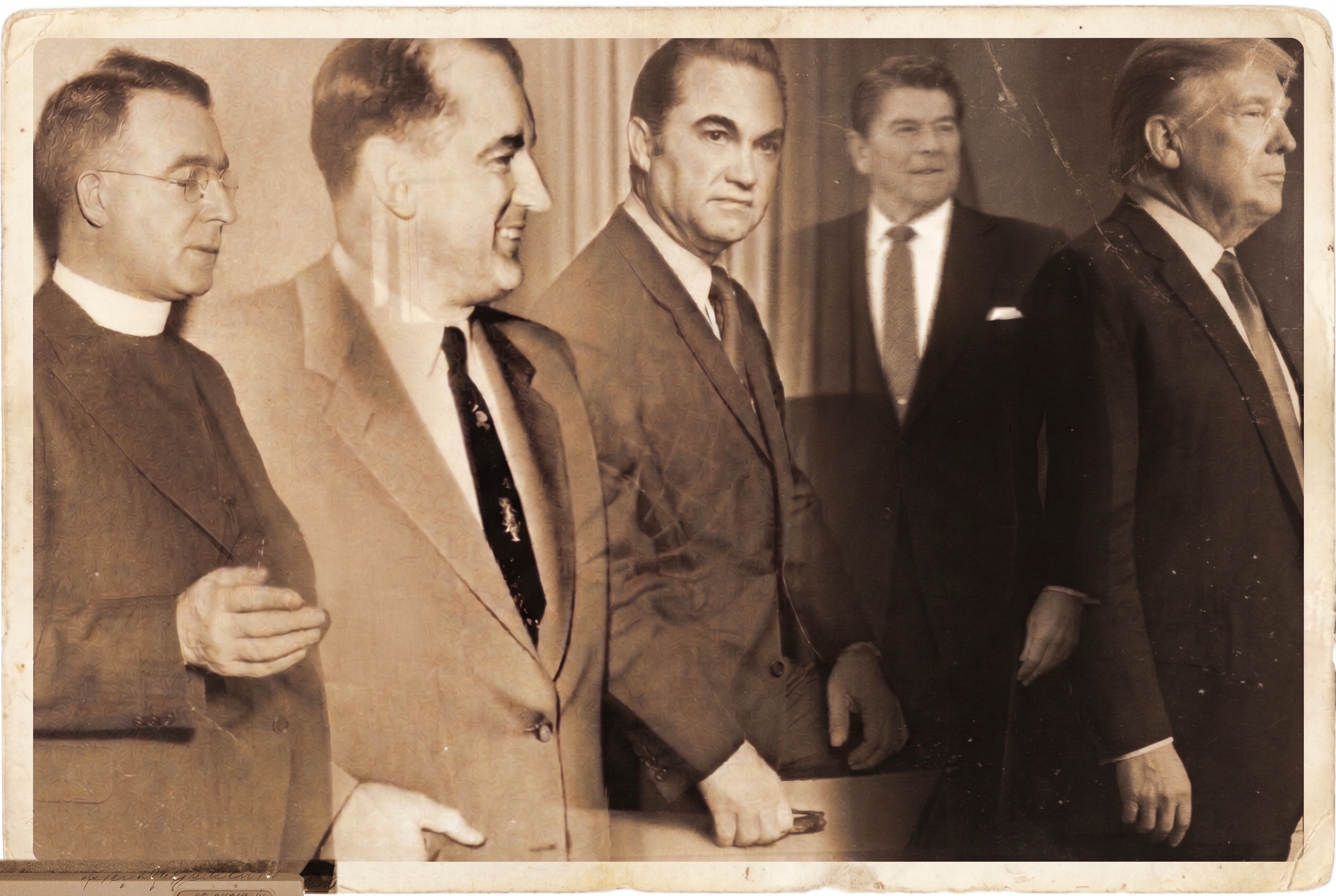
In March 1945, while the war raged on, the military released a fact sheet on fascism and how to spot it in America. They said any fascist attempt in America would work under the guise of “super-patriotism” and “super-Americanism” (War Department, 1945). The search for American fascism began. Fascism is outdated, and modern regimes figured out boots and blood provide no long-term investment. Regimes discovered its easier to manipulate people slowly than to burn resources on violent control. Fascism stays in the history; authoritarianism does the work from here. American authoritarianism has to get past a government built to split power among three branches and fifty states. Fringe groups kept trying anyway. The American right has tried it most often and most visibly, and every time the attempt was seen and brushed off. McCarthyism died in the Senate and survived as an idea in the John Birch Society, and its habits of naming traitors and hunting communists run through the current Trump administration. Every right-wing movement that failed left something behind in the Republican Party. Similar to feralization, the party shed its moderate elements one by one and blended in the aggressive ones, until only the worst remained. MAGA is the product of these movements in which observers misjudged how long the radical right of the 1960s would last. MAGA today is an amalgam of far-right fragments, each decade adding its own.
America is a pluralistic society, a dynamic shift of cultures and values that work together, consistently causing negotiations between opposing views, which prevents one group from taking control. Three branches of government, insulated from the others to thwart absolute control. Executive, Judicial, and Legislative. Different levels of judges throughout the country: U.S. district court judges. U.S. court of appeals judges. Supreme Court justices. A complex system meant to mitigate an infestation of tyranny. Many have tried, but the system is too deliberately scattered for any one group to take hold of it all.
America built its identity on freedom and free enterprise, and that shaped the costume any authoritarian movement here has to wear: flags and patriotism in place of European uniforms and state ownership. The deal is simple: become successful or fall flat on your face. America prides itself on the image of the hard-working middle class, while poverty stubbornly lingers. Worker rights have been a constant issue, teetering between rights given and rights stripped. Some leaders want Americans to flourish. While others only care about the rich, leaving the lower classes in filth. Middle ground has been found before, and it worked. Every person wants to stand alone, but out of many we are still one. This would make raw European fascism contradict itself the moment it landed here. Americans would see right through it. Even the staunchest American liberal would draw the line at total control by the government. American fascism would use a flag and hard hat. It would be nationalistic and preservatist, guarding the image of the hardworking man and his traditional American values. It would imitate freedom to lure in even the most independent American into conformity. The conformity would imitate the American instinct. It would be sold on the free market of Americanism.
Some date the radical right to the 1960s, but it had been showing up in pockets long before. The first movement that captured the essence of fascism started in the 1930s by radio priest, Father Charles E. Coughlin. In 1938, he created the Christian Front and told its members that they didn’t have to be, “afraid of the word ‘fascist” (Lipset & Raab, 1970, p. 170). Coughlin’s fascism spoke to the populist, the worker, the unemployed American who felt left behind and believed society and the elites had abandoned them. Arthur Schlesinger Jr. said:
They came, in the main, from the ranks of the self-employed, who, as farmers or shopkeepers or artisans, felt threatened by organized economic power, whether from above, as in banks and large corporations, or from below, as in trade unions (Arthur M. Schlesinger, Jr., The Politics of Upheaval (Boston: Houghton Mifflin, 1960), p. 68).
They hated the elites, and the list of people they blamed for their stalled lives ran from Wall Street lawyers to Park Avenue to the learned men of Harvard and Yale (Lipset & Raab, 1970, p. 169). Coughlin hated communism for being goddless, internationalist, and a false fix for capitalism (p.169). This manifested into a proletariat-type fascism. The enemy was always abstract, every change to who they felt was the enemy: bankers and roosevelt then the Jews by 1938 (pp. 169–171, 180). Coughlin wanted to maintain social hierarchies, turn nativism on its head, an aimed at the old protestant establishment. The punishment fell on whoever got labeled alien. In 1936 he promised to quit the airwaves if his candidate fell short of nine million votes; Lemke got under 900,000. Coughlin went quiet for about three months and came back (p. 170).
Joseph McCarthy was a politician with a conspiratorial streak, who took the darkest parts of the American mind and used them by feeding into fear and hate. The fear, again, was status insecurity. The anxieties changed shape after the war: new wealth replaced pervasive poverty as the worry, and communism replaced fascism as the enemy abroad (p. 214). Economic conservatives, urban and agrarian, bristled at the New Deal’s reforms and wanted them rolled back (p. 215). They were afraid they would lose their money. The Depression had stripped business of its prestige, and a war against fascism, which people filed on the right, kept liberal sentiment in charge from 1930 to 1945 (p. 214). Peace let the conservative side go back on the offensive (p. 215). Communism infiltrated the liberal party in the thirties and forties, a few of them spies. McCarthy used this to push a full scale hunt for ideological deflectors (pp. 215, 224).
For fifteen years, the Right dropped the ball—now, they’ve finally stepped back into the fight against the liberal establishment. Senator Joseph McCarthy was ready to give anti-communism its mainstream debut. On February 9, 1950, McCarthy began his witch hunt to defame the liberal progress, claimed he possessed the names of Communist Party members who worked for the State Department, and that the Department knew. According to press reports, he said:
While I cannot take the time to name all of the men in the State Department who have been named as members of the Communist Party and members of a spy ring, I have here in my hand a list of two hundred and five that were known to the Secretary of State as being members of the Communist Party and who nevertheless are still working and shaping the policy of the State Department (Rovere, 1960, p. 125).
Liberals and Democrats who had helped millions found themselves targets, as if they had always been the enemy. The postwar ultraright ran a doctrine Lipset and Raab call Social Communism, a mirror of the Communist line before 1934 that Socialists and liberals were Social Fascists. Its magazine, The Freeman, argued that every welfare state and planning measure was a step toward a totalitarian Communist state, and it dragged the New Deal, Americans for Democratic Action, and the CIO’s Political Action Committee into the same charge (1970, p. 217). Communism was the left’s kryptonite once more, and the right knew exactly where the rock was kept.
The radical right went on the offensive and a pattern had emerged: take something the left built to better american lives and paint it as proof of failure. The left played dirty too, but this was becoming a habit for the radical right. McCarthy had ultimately failed. The party felt he had become more costly than useful, and after a senate vote, he was cast out. He died three years later (pp. 235–236).
Robert Welch founded the John Birch Society in 1958, a far-right, ultraconservative advocacy group whose anti-communism ran well past the ordinary kind. Welch wanted every government on earth cut to a third of its present size, and the income tax abolished. Alongside the Birch Society was the Americans for Constitutional Action, which wanted political education against “compulsory participation in Social Security, mandatory wage rates, compulsory membership in labor organizations, fixed rent controls, restrictions on choice of tenants and purchasers of one’s property”(Dionne, 2012). The late fifties filled up with right-wing organizations built to push a conservative agenda. By 1968, Welch was handing his members a plot to match: a third world war with Communists steering both sides, dressed up with racial riots, a sabotaged dollar, hippies on campus, pornography in every medium, a Supreme Court that shielded criminals, the spread of the idea that God had died, and a family left to weaken (Welch, as cited in Lipset & Raab, 1970, pp. 250–251). The Birch Society was condemned by the left and the right and dismissed as a fringe radical-right group.
Welch traced the whole business to the Illuminati, a Bavarian society dissolved in 1785, and demoted Communism to one of its instruments; he even floated the idea that Karl Marx wrote the Manifesto as an agent of a branch of it (Lipset & Raab, 1970, pp. 252–253). The Illuminati as a nefarious plot to control the world was never real, but was able to outlast nearly two centuries of debunking as its motivations were vague and ever changing. You can’t disprove something when the claims are extraordinary. Politicians became marionettes to the communist, in this telling. In the Society’s publications, Kennedy, Johnson, and Nixon were dupes of the Communists, and Eisenhower, the general who won the war, was a conscious agent (Lipset & Raab, 1970, p. 256). Colleges and churches were declared controlled by communists. Anti-elitism drifted back toward the mainstream, and the professors, the intellectuals, and the liberal wing of the Republican Party all stood accused of carrying Moscow’s water (Welch, 1966).
The Birch Society fought civil rights legislation on the grounds that it swelled federal power and ignored the one remedy the Society endorsed, individual initiative by Black Americans themselves (Lipset & Raab, 1970, p. 267). Subversive groups and communism were blamed for fueling the civil rights movement. In August 1963, days after the March on Washington, William Sullivan, head of the FBI’s domestic intelligence division, marked Martin Luther King Jr. as the most dangerous Black man in America’s future from the standpoint of communism and national security (Silverman, 2018). The Society still claimed a thousand Black members, listed Black speakers on its roster, and funded scholarships for Black students, and within hours of the Watts riots in 1965 it sent Los Angeles chapters orders for an anti-civil rights propaganda drive built to capitalize on white backlash (Epstein & Forster, 1966, as cited in Lipset & Raab, 1970, p. 268).
George Wallace was a building block for the radical right because his campaign, though it lost, showed the Republican Party where the votes were, and the Southern Strategy followed (Diamond, 1995, p. 13). Wallace, the 45th governor of Alabama, was a segregationist Democrat in the mold of Huey Long, a demagogue with a populist pitch and a taste for the strong hand (Lipset & Raab, 1970, p. 351). Neither the left nor the right wanted him. James Ashbrook, in October, 1968, the head of the right-wing American Conservative Union, stated, “True conservatism cannot be served by George Wallace. At heart he is a Populist with strong tendencies in the direction of a collectivist welfare state” (Lipset & Raab, 1970, p. 348). Wallace spoke to the people who felt left behind by the establishment, workers and union members especially (Lipset & Raab, 1970, p. 348), and aimed them at professors, bureaucrats, and Washington. Ten million votes and five southern states went his way, and Birchers and the Citizens’ Councils helped run the machinery (Diamond, 1995, p. 143). He lost. Conservatives said Wallace wasn’t conservative, but the Republican Party was quick to fold his issues into the Nixon Southern Strategy (Diamond, 1995, p. 13).
If Wallace was a tributary, Reagan was the confluence. The New Right was already a coalition of corporate backed think-tanks, republican political strategist, and a newly organized conservative evangelicals—formed in the 1970s. The were considered a fusionist mix of, “economic libertarianism, traditional “law and order” morality, and militarist anticommunism” (Diamond, 1995, p. 133). The libertarian wing wanted welfare and regulation rolled back; the anticommunists drew in the neoconservatives and the hawks. The Heritage Foundation released The Mandate for Leadership which was a conservative playbook to, “Continuing the Conservative Revolution". The aim was to “ensure the continuation and permanence of the Reagan Revolution” (Butler et al., 1984). Reagan took 66% of the white vote, taking the majority of the southern white vote (Roper Center for Public Opinion Research, n.d.). Liberals and progressives were cast as the villains by a Legion of Doom that mistook itself for the Justice League.
The decades that followed brought new ideologies into the Republican Party, and conservatism kept the keys. Moderates tried to steer the party. McCain lost in 2008 and left it without a clear leader, his own advisors feuding with his running mate (Skocpol & Williamson, 2012, p. 6). Romney drew suspicion from Tea Partiers, who disliked his health plan and did not trust him (Skocpol & Williamson, 2012, p. 195). The economy collapsed in 2008, and the bailouts and the stimulus package that followed hardened Republican hostility toward the new president (Skocpol & Williamson, 2012, pp. 6–7). On February 19, 2009, a CNBC reporter named Rick Santelli ranted on air against foreclosure relief and called for a tea party, and the name stuck (Skocpol & Williamson, 2012, p. 7).
By 2015, Republicans were so done with Obama that they somehow convinced themselves that health care for all is bad and that Obama created racism. Opponents of the New Deal had walked the same road, resisting a program that lifted millions out of ruin. They were beaten down and had completely lost trust in the establishment. Trump enters the room and promises to drain the swamp, remove the ACA, and build a wall to keep the Mexicans out (Trump, 2015). He was anti-establishment and unapologetic about it. He was using overt prejudice and exclaimed he would not be bogged down by political correctness.
Trumps second term played like a reunion tour for the coalition Reagan assembled: the New Right, the neoconservatives, the evangelicals. Trump, the man who had promised to drain the swamp, had become a resident, a second-term Reagan with his energy back. The New Right had walked through Emerald City, fought off the wicked liberal witch, and asked the Great and Powerful Oz to address their wishes. The warhawks got an Iran war (Gringlas, 2026). The evangelicals had proof of persecution (Trump, 2025). The racists watched brown people get deported(U.S. Department of Homeland Security, 2025). Behind the curtain stood Coughlin, Long, Welch, McCarthy, and Wallace, applauding the show they created.
We were warned eighty years ago by the military that American fascism would arrive under the guise of “Americanism.” Each time it came, moderates pushed it back or it defeated itself, and each time a piece stuck behind to feed the next movement. Like Dr. Manhattan reassembling himself atom by atom, the body re-formed while people watched and never took it seriously enough. It is here now, and the accusations are the same ones. The left is accused of communism and socialism, and every progressive movement is blamed on some subversive group. MAGA has engulfed the Republican Party and grown more radical, more conspiratorial, and more prejudiced (Neumann & Kaufman, 2025; Newman et al., 2021; Ruisch & Ferguson, 2022). The deep state never materialized. Then a video leaked of a DSA Zoom call discussing a contingency plan in case Trump tries to stop the midterms (Sellers, 2026). MAGA had a contingency plan if Biden won the 2020 election: storm the Capitol. Contingency plans are not proof that something will happen. MAGA now claims the deep state was inside the room all along, and that it was the DSA (Sellers, 2026). The radical right has molded the party into the worst parts of the right and dragged authoritarianism along with it. Authoritarianism was handed down to the Republican Party, decade after decade, until it was fully realized.
References
Lipset, S. M., & Raab, E. (1970). The politics of unreason: Right-wing extremism in America, 1790–1970. Harper & Row.
United States War Department, Information and Education Division. (1945, March 24). Fascism! (Army Talk Orientation Fact Sheet No. 64). Internet Archive. https://archive.org/details/ArmyTalkOrientationFactSheet64-Fascism
Rovere, R. (1960). Senator Joe McCarthy. Meridian Books.
Welch, R. (1966). The new Americanism: And other speeches and essays. Western Islands.
Silverman, J. (2018). “The most dangerous Negro”: Martin Luther King Jr. and the FBI. University Writing Program, Brandeis University.
Epstein, B. R., & Forster, A. (1966). Report on the John Birch Society 1966. Vintage.
Butler, S. M., Sanera, M., & Weinrod, W. B. (Eds.). (1984). Mandate for leadership II: Continuing the conservative revolution. The Heritage Foundation.
Roper Center for Public Opinion Research. (n.d.). How groups voted in 1984. Cornell University. https://ropercenter.cornell.edu/how-groups-voted-1984
Trump, D. J. (2015, June 16). Remarks announcing candidacy for president in New York City (G. Peters & J. T. Woolley, Eds.). The American Presidency Project. https://www.presidency.ucsb.edu/documents/remarks-announcing-candidacy-for-president-new-york-city
Hochschild, A. R. (2016). Strangers in their own land: Anger and mourning on the American right. The New Press.
Skocpol, T., & Williamson, V. (2012). The Tea Party and the remaking of Republican conservatism. Oxford University Press.
Gringlas, S. (2026, February 28). Iran strikes were launched without approval from Congress, deeply dividing lawmakers. NPR. https://www.npr.org/2026/02/28/nx-s1-5730203/iran-israel-trump-congress-strikes-reaction
Trump, D. J. (2025, February 6). Executive Order 14202: Eradicating anti-Christian bias. The White House. https://www.whitehouse.gov/presidential-actions/2025/02/eradicating-anti-christian-bias/
U.S. Department of Homeland Security. (2025, April 29). 100 days of making America safe again. https://www.dhs.gov/news/2025/04/29/100-days-making-america-safe-again
Newman, B., Merolla, J. L., Shah, S., Lemi, D. C., Collingwood, L., & Ramakrishnan, S. K. (2021). The Trump effect: An experimental investigation of the emboldening effect of racially inflammatory elite communication. British Journal of Political Science, 51(3), 1138–1159. https://doi.org/10.1017/S0007123419000590
Ruisch, B. C., & Ferguson, M. J. (2022). Changes in Americans' prejudices during the presidency of Donald Trump. Nature Human Behaviour, 6(5), 656–665. https://doi.org/10.1038/s41562-021-01287-2
Neumann, C. S., & Kaufman, S. B. (2025). Malevolent vs. benevolent dispositions and conservative political ideology in the Trump era. Journal of Research in Personality, 118, Article 104638. https://doi.org/10.1016/j.jrp.2025.104638
Sellers, B. (2026, October 22). If seditionists don't face accountability, everyday Americans will pay the price. RedState. https://redstate.com/ben-sellers/2026/10/22/if-seditionists-dont-face-accountability-everyday-americans-will-pay-the-price-n2208447
Dionne, E. J., Jr. (2012). Our divided political heart: The battle for the American idea in an age of discontent. Bloomsbury USA.